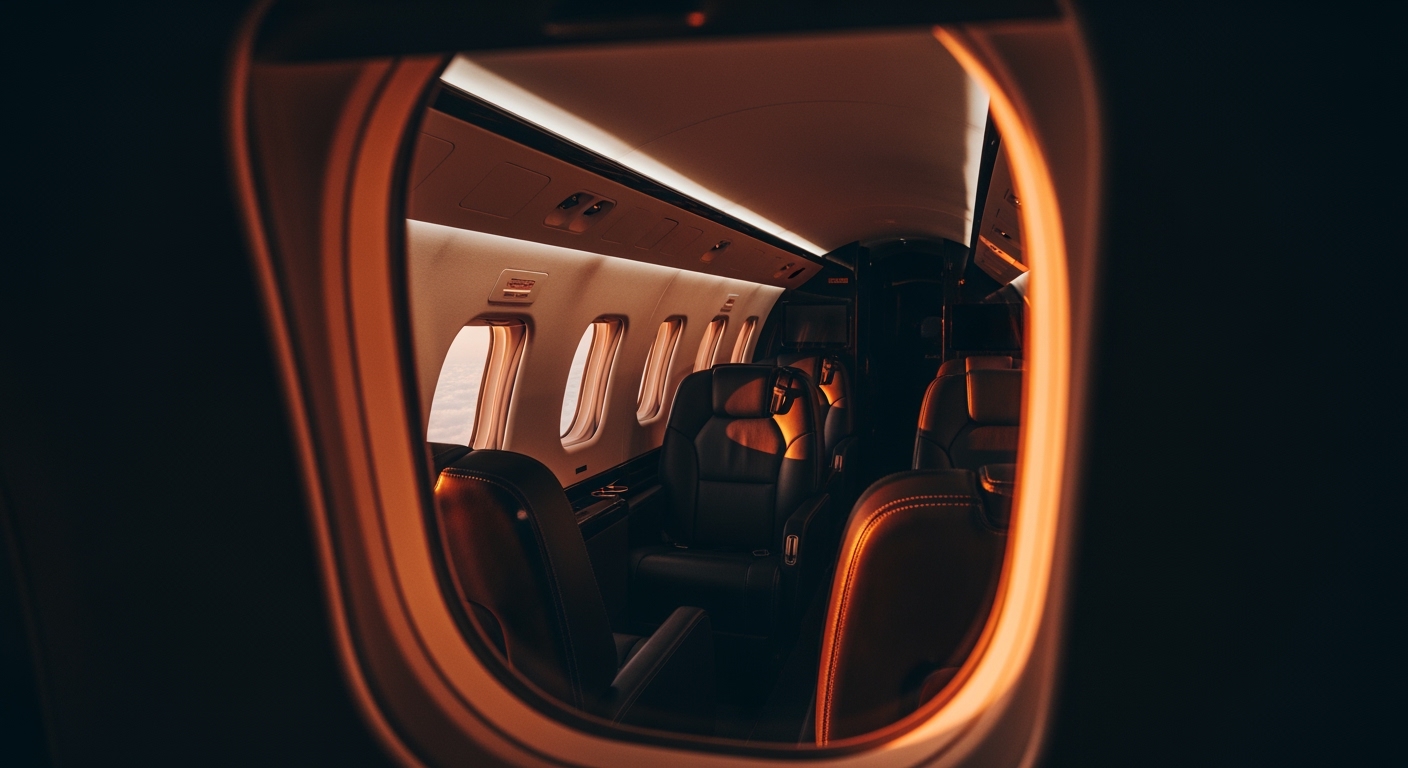
Fractional ownership, jet card, fleet and alternatives
NetJets: our full review
The fractional ownership pioneer examined in depth: model, global fleet, real pricing and more flexible alternatives.

About NetJets
NetJets is quite simply the largest private aviation company in the world. Founded in 1964 under the name Executive Jet Aviation, the company revolutionized the industry in 1986 by inventing fractional ownership, under the leadership of Richard Santulli. Since 1998, NetJets has belonged to Berkshire Hathaway, Warren Buffett’s conglomerate, which gives it unparalleled financial strength in the sector.
Based in Columbus (Ohio), the company operates, together with its subsidiary NetJets Europe, a fleet of approximately 858 aircraft (mid-2026), growing toward more than 900 jets by end of 2026. More than 40% of Fortune 100 companies are among its clients, and the company carries more than 700,000 passengers per year.
Unlike a broker, NetJets is an operator: the company owns its aircraft and primarily offers clients the opportunity to purchase a fraction of one, rather than chartering on an ad-hoc basis.
The NetJets model: fractional ownership, jet card and rental
NetJets’ offering breaks down into three main programs.
Fractional ownership
This is the historical core of NetJets. You buy a share of an aircraft (a minimum of 1/16th, equating to roughly 50 hours per year), on a 5-year commitment. In return: guaranteed access 365 days a year, with as little as 4 hours’ notice for domestic US flights (10 hours for transatlantic). The model includes monthly management fees and an hourly cost charged per flight.
Jet card (Card275, Card320)
For those who do not wish to invest in a share, NetJets offers flight cards: blocks of 25 prepaid hours at a fixed hourly rate. The Card275 starts at around $215,000 (25 h on a Phenom 300, ~$8,600/h tax included), the Card320 at around $280,000. In Europe, the entry point is approximately €212,000. Advantage: no management fees. Disadvantage: blackout dates and no ownership stake.
25-hour rental
An access option with no ownership or equity, designed to test the service before a heavier commitment.
The fleet
NetJets operates the largest private fleet in the world: approximately 858 aircraft covering every cabin category, from manufacturers including Bombardier, Embraer, Cessna, Gulfstream and Dassault. A few key figures:
- Light jet: Embraer Phenom 300 (≈165 aircraft)
- Super-midsize: Cessna Citation Latitude (≈261), Longitude, Challenger 350
- Large cabin: Challenger 650, Falcon 2000
- Ultra-long-range: Global 5000, 6000, 7500 and 8000
This fleet depth is NetJets’ primary argument: where competing programs line up 100 to 150 aircraft, NetJets can guarantee an aircraft even on peak days. The company has also placed orders for nearly 2,000 jets over the long term.
Safety and reliability
This is one of NetJets’ strongest points. Backed by Berkshire Hathaway, which has zero tolerance for reputational risk, the company applies one of the most rigorous safety programs in the sector: crew training, maintenance standards and audits conducted at industrial scale. The share buyback guarantee, underpinned by the group’s financial strength, eliminates the solvency anxiety that sometimes hangs over private aviation.
NetJets’ strengths
Unmatched fleet depth: with nearly 858 aircraft, NetJets offers genuine availability on peak days that no 100-to-150-aircraft program can equal.
Guaranteed availability: 4 hours’ notice for domestic US flights, 10 hours for transatlantic, with contractual operational priority.
Financial solidity: Berkshire Hathaway backing guarantees stability, share buyback and long-term viability.
Benchmark safety: one of the most demanding safety programs on the market.
Coverage and reputation: a global standard, adopted by more than 40% of Fortune 100 companies.
Identified weaknesses
Tied-up capital: fractional ownership requires a purchase of several hundred thousand dollars, plus monthly management fees. The entry ticket is very high.
5-year commitment: the fractional model locks clients into a long-term contract, poorly suited to variable or occasional needs.
Exposure to depreciation: share ownership means asset depreciation; resale value depends on market cycles.
Blackout dates on cards: the Card275 carries up to 90 blackout days, limiting flexibility during high-demand periods.
Only profitable at heavy usage: below 50 hours per year, on-demand charter remains significantly more economical than NetJets.
Who is NetJets recommended for?
NetJets is aimed at very heavy travelers (corporations, executives, wealthy families) who fly 50 to 400 hours per year, require absolute guaranteed availability and are prepared to commit significant capital for 5 years in exchange for complete peace of mind.
Conversely, occasional or irregularly flying travelers, those who refuse long-term commitment or exposure to depreciation, and those who simply want to pay per flight will find a far better cost-to-flexibility ratio with an independent broker.
Private Jets Connect: the no-commitment alternative
Compared to NetJets’ capital-intensive model, Private Jets Connect offers a radically more flexible approach:
- Zero capital, zero commitment: no share to buy, no 5-year contract — you pay only for the flights you take.
- No depreciation exposure: you own no asset, so no resale risk and no exposure to market cycles.
- Every type of aircraft: from Very Light Jet to ultra-long-range, we select the ideal aircraft for each trip.
- Total independence: as a broker, we compare hundreds of operators with no bias toward a single fleet.
- Transparent pricing: a clear structure and a quote tailored to your real need, with no monthly management fees.
Request a free quote from Private Jets Connect and compare for yourself.
Verdict and rating
NetJets is, without question, the global benchmark in private aviation. Its vast fleet, guaranteed availability and Berkshire Hathaway backing make it an exceptional choice for very heavy, regular travelers. The downside: considerable tied-up capital, a 5-year commitment and a model that only becomes cost-effective at high volumes. For occasional or variable use, the flexibility of an independent broker like Private Jets Connect remains far more relevant.
| Criterion | Rating |
|---|---|
| Fleet depth | 10/10 |
| Guaranteed availability | 9/10 |
| Safety & solidity | 10/10 |
| Flexibility | 5/10 |
| Value for money (occasional use) | 5/10 |
| Overall rating | 8.5/10 |
NetJets’ official website is available at netjets.com for any direct enquiry.
Popular private jet destinations
Why choose Private Jets Connect
Guaranteed security and confidentiality
Maximum protection of your data and travel in complete discretion
Access to over 5,000 available jets
The world's largest fleet at your disposal
24/7 Service with a dedicated advisor
Personalised assistance at any time, anywhere in the world
Negotiated rates, no hidden fees
Total transparency and best prices guaranteed
Frequently Asked Questions
Everything you need to know about our services
Is NetJets a broker or an operator?
NetJets is an operator that runs the largest privately owned fleet of jets in the world. Its core business is fractional ownership (you buy a share of an aircraft), complemented by jet cards. This is the opposite of a broker like Private Jets Connect, which owns no aircraft but selects for each flight the best option from among hundreds of operators, with no purchase or commitment required.
How much does NetJets cost?
Entry is via the Card275 at approximately $215,000 for 25 hours on a Phenom 300 (around $8,600/h, federal tax included). With fractional ownership, a 1/16th share (≈50 h/year) in a light jet costs roughly $500,000 to $850,000 to purchase, plus monthly management fees and an hourly cost. Over 50 hours, the all-in annual cost frequently reaches $400,000 to $600,000.
What is the difference between NetJets fractional ownership and a jet card?
Fractional ownership means buying a share of an aircraft (5-year commitment, capital tied up, guaranteed access 365 days a year). A jet card is a block of prepaid hours with no ownership stake, simpler but with blackout dates. Roughly half of fractional clients begin with a card.
NetJets or Private Jets Connect: which to choose?
NetJets is unbeatable for very heavy travelers (50 to 400 h/year) who are prepared to commit significant capital for 5 years. Private Jets Connect, an independent broker, is better suited if you fly occasionally or irregularly: no commitment, no capital investment, pay per flight, access to every type of aircraft and transparent pricing.