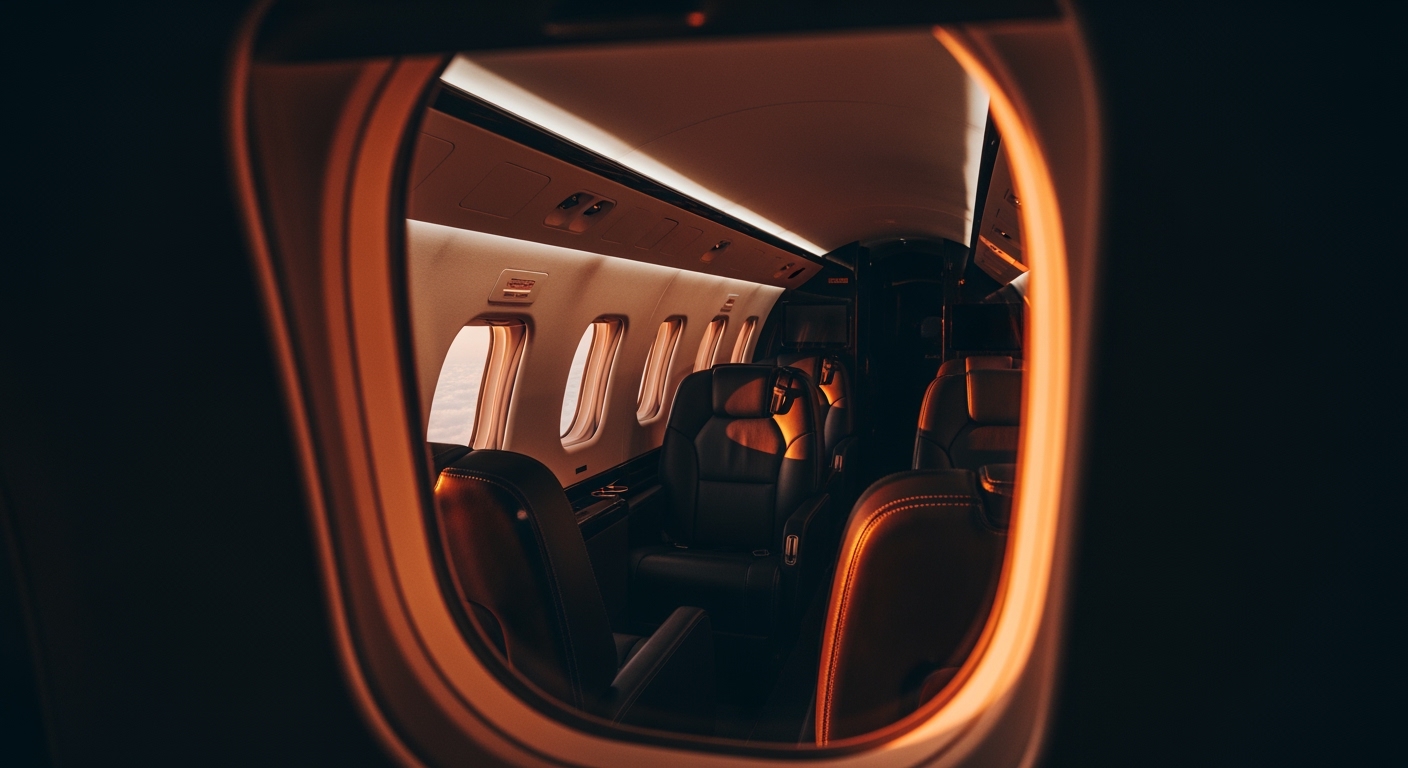
Night flights, sleeping arrangements and overnight comfort
Private jet at night: can you fly and sleep on board?
Flying at night on a private jet, sleeping on board and arriving refreshed: what you need to know.
Flying at night on a private jet: yes, and it is actually an advantage
The answer is simple: yes, you can fly at night on a private jet. Better still, the night flight is one of the great attractions of private aviation. Where scheduled airlines impose their timetables, a private jet takes off at whatever time suits you, including in the middle of the night.
The idea is elegant: turn travel time into rest time. You board in the evening after a day of work or a dinner, you sleep during the flight, and you land in the morning, fresh for a meeting or ready to enjoy your destination. The journey no longer costs you a day — it blends into your night.
Why choose a night flight
Three benefits are consistently cited by those who adopt the overnight flight.
- Saving productive time. A night in the air means a full day recovered on arrival. You sacrifice neither a working morning nor an evening with family.
- Sleeping during the journey. The quiet on board, the absence of unknown neighbours and the personal space make sleep far more natural than in a commercial cabin.
- Arriving rested and ready. Landing early in the morning after a few hours of sleep allows you to go straight into the day ahead, without the fatigue of a daytime flight followed by a shortened night in a hotel.
For transatlantic routes or journeys to the Middle East, this pattern is particularly apt: you take off from Europe in the evening, sleep, and arrive at your destination for the start of the local day.
Sleeping on board: from reclining seat to a proper bed
Everything depends on the aircraft and the length of the flight. The longer the distance, the more the cabin is designed for rest.
Long-range jets: proper sleeping cabins
On large aircraft (Bombardier Global, Dassault Falcon, Gulfstream, or business jets such as the BBJ and ACJ), the cabin converts into a sleeping space. The crew makes up the beds while you dine: mattresses unfolded over the divans, full bedding, pillows and duvets. Some aircraft even feature a separate private bedroom at the rear, with a fixed bed and sometimes an en-suite bathroom.
The result comes close to a flying hotel room: you lie down fully flat in hushed silence. This is the ideal configuration for very long distances where a full night’s sleep is the goal.
Light and midsize jets: reclining seats and divans
On a light or midsize jet, there is no fixed bed, but reclining seats that fold back generously, often enough to form a near-flat surface. Many cabins also include a divan that converts into an additional sleeping berth. For a two-to-four-hour night flight, this is more than sufficient for a comfortable doze.
The key takeaway: the aircraft must be chosen to match your need for sleep. A broker steers you towards the right category based on flight duration, number of passengers and your genuine desire to lie down.
Overnight comfort on board
Beyond the sleeping arrangement, the night experience is shaped by details. The temperature can be set to your preference, ambient lighting is dimmed, and the silence of insulated cabins cuts out engine noise. You have your own space, with no passenger traffic or untimely announcements.
The crew also adapts its service to the late hour: a light meal served before sleep if you wish, then complete discretion to let you rest. On waking, breakfast can be offered before landing. Everything is designed to respect your rhythm, not the other way around.
The restrictions to know: airport curfews
This is the only real watchpoint for a night flight. Certain airports, often located near residential areas, impose a curfew: no take-offs or landings are permitted during a nocturnal window, typically between 11 pm and 6 am. These restrictions aim to limit noise disturbance.
In practice, this does not prevent you from flying at night, but may require an adjustment: a slight shift in timing, or a switch to a nearby airport that operates around the clock. This is precisely the kind of constraint a broker anticipates for you. To understand how airports and their schedules shape a flight, see our guide on airport types and their curfews.
Checking these time windows in advance avoids the classic pitfall: an ideal slot on paper that turns out to be impossible once local constraints are factored in.
How to organise a night flight
The logistics of a night flight do not differ fundamentally from a daytime flight, with a few nuances. You specify your route, desired times and sleep requirements; the broker verifies the availability of suitable aircraft, the curfews at the relevant airports and configures the cabin accordingly (beds made up, bedding, lighter service).
The booking process remains the same as for any charter: we detail each step in our guide on how to book a private jet. The difference lies mainly in anticipating timing constraints — exactly where an independent broker’s expertise comes into its own.
Conclusion
Flying at night on a private jet means turning a travel obligation into a useful night’s sleep. Long-range jets offer genuine sleeping cabins, other aircraft have generously reclining seats, and the entire service adapts to your rhythm. The only point to plan for is the curfews at certain airports, which an independent broker checks systematically to secure your slot. Well prepared, the night flight becomes one of the finest uses of private aviation.
Popular private jet destinations

Why choose Private Jets Connect
Guaranteed security and confidentiality
Maximum protection of your data and travel in complete discretion
Access to over 5,000 available jets
The world's largest fleet at your disposal
24/7 Service with a dedicated advisor
Personalised assistance at any time, anywhere in the world
Negotiated rates, no hidden fees
Total transparency and best prices guaranteed
Frequently Asked Questions
Everything you need to know about our services
Can you really sleep on board a private jet at night?
Yes. On long-range jets, the crew converts the cabin into a proper sleeping area with made-up beds and full bedding. On lighter aircraft, seats recline to form an almost flat surface. The quiet and personal space of a private jet make sleep far more achievable than in business class on a scheduled service.
Do all private jets have beds?
No. True beds are the preserve of long-range jets (Global, Falcon, Gulfstream, BBJ/ACJ) on long-haul distances. On a light or midsize jet, you have reclining seats and sometimes a convertible divan, but not a fixed bed. The right aircraft is chosen based on flight duration and your need for rest.
Are there restrictions for flying at night on a private jet?
The main constraint comes from curfews at certain airports, which ban take-offs and landings during a nocturnal window. The solution often involves switching to a nearby airport that operates around the clock. A broker checks these schedules in advance to secure the slot and avoid unpleasant surprises.
Does a night flight cost more?
There is no systematic surcharge linked to the hour itself. The price depends on the route, the aircraft and availability. A night flight can even prove advantageous when an aircraft is better positioned overnight. However, overnight airport-opening fees or night handling charges may be added at certain airfields.