Distance, access, price and complementarity
Private jet or helicopter: which one to choose?
When to favour the helicopter, when to favour the jet, and how to combine them for a door-to-door journey.
Private jet or helicopter: two tools, two logics
Pitting the private jet against the helicopter makes little sense: they are two aircraft designed for different missions. The helicopter is a specialist of short distances and access to locations without a runway. The private jet is the expert of medium and long distances, at high speed and in a comfortable cabin.
The real question is therefore not “which is better?”, but “which one for which journey?”, and very often, “how to combine them?”. This is precisely what we will detail, criterion by criterion.
The comparison table
| Criterion | Helicopter | Private jet |
|---|---|---|
| Ideal distance | Up to ~250–300 km | From ~300 km to several thousand km |
| Cruising speed | ~200 to 300 km/h | ~700 to 900 km/h |
| Range | Limited (often < 600–700 km) | High (up to transcontinental) |
| Access | Helipad, heliport, cleared ground | Airport and FBO (runway required) |
| Capacity | Around 4 to 7 passengers | 4 to 16+ passengers |
| Weather sensitivity | High (low-altitude flight) | Low (flight above disturbances) |
| Ideal use | Last mile, runway-free locations | Main leg, distance and comfort |
Distance and range: the decisive criterion
This is the factor that resolves the question most quickly. The helicopter shines on short trips, typically under 250 to 300 km: a Nice–Monaco transfer, a Cannes–Saint-Tropez run, or a link between two nearby points that no fast road connects efficiently.
The private jet, meanwhile, comes into its own as distance increases. On a Paris–Nice, a Geneva–Ibiza or an intercontinental flight, its range and speed make the helicopter impractical. For precise calibration of the aircraft by number of passengers and distance, our dedicated guide helps you choose a private jet by passengers and distance.
Speed and journey time
A helicopter typically cruises between 200 and 300 km/h. That is more than sufficient to cover a short distance faster than by road, especially in congested or mountainous terrain. But over a real distance, the gap becomes enormous: a private jet flies three to four times faster.
The arithmetic is straightforward. Over 200 km, the helicopter and the jet are comparable once access to infrastructure is taken into account. Over 800 km, the jet arrives while the helicopter is still far from its destination. The helicopter’s speed is a local advantage, never one of distance.
Access: helipad versus airport and FBO
This is where the helicopter makes a decisive comeback. It can land at a helipad, a heliport, on the deck of a yacht or any approved cleared ground. It therefore serves points that no aircraft can reach: a ski resort, an isolated villa, a helipad in the heart of a city.
The private jet needs a runway and operates from a FBO (the private terminal at the airport). This is an advantage in itself, since FBOs offer a fast and discreet process, but it does mean travelling to the airport. Depending on the destination, the type of airfield changes the picture: our guide on airport types for a private jet covers these aspects.
Comfort and weather sensitivity
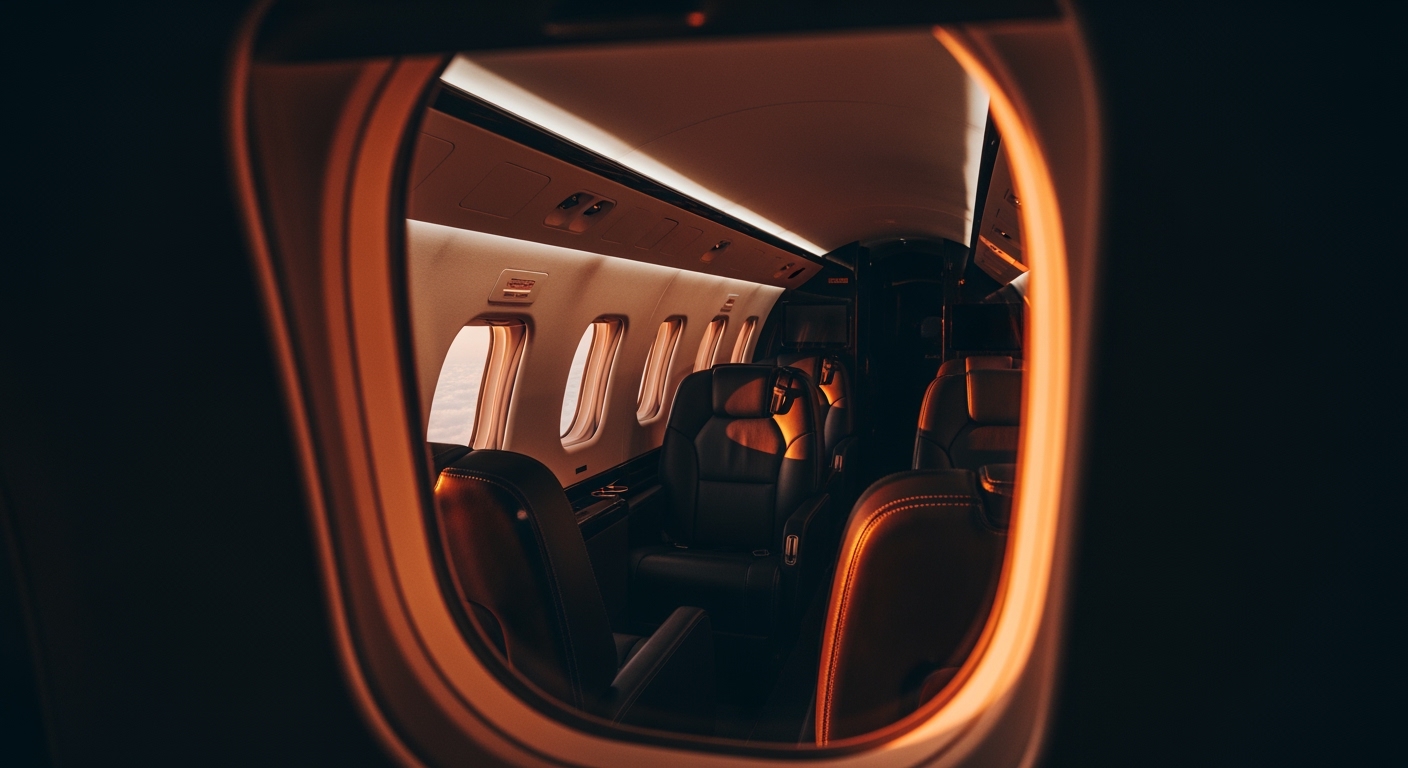
In the cabin, the private jet wins on comfort: pressurisation, controlled noise levels, space to work or rest, and the ability to fly above turbulence. The helicopter offers a more spectacular experience, with breathtaking views at low altitude, but less plush comfort and a noisier environment.
Weather also widens the gap. The helicopter flies low and remains more sensitive to fog, strong winds and icing, which can delay or cancel a flight. The jet, climbing to altitude, is far more reliable on timing. For an appointment at a fixed hour, this is a strong argument in favour of the jet for the main leg.
Indicative pricing
On the budget side, a helicopter often shows a lower hourly cost than a jet (as a general indication, without commitment). But this figure can be misleading: since it flies slower and covers less distance, the total cost rises rapidly as the distance increases.
The practical rule is as follows. On a short hop, the helicopter is generally more economical and faster door to door. Over a medium or long distance, the jet offers a far better time-to-cost ratio, covering in one hour what the helicopter would take several hours to reach. For a detailed breakdown of fares, see our guide on private jet charter prices.
Complementarity: the smart play
The smartest scenario is not to choose, but to combine. The jet handles the main leg between two airports, then the helicopter takes over for the last mile to a runway-free point. This is door-to-door transport at its most refined.
A few concrete examples:
- Airport to ski resort: jet to the nearest airport, then helicopter directly to the altiport or resort helipad.
- Airport to yacht: jet to the coast, then helicopter to the yacht’s deck or a coastal heliport.
- Airport to city centre: jet to the regional airfield, then helicopter to the urban heliport to avoid traffic.
This orchestration requires coordinating two aircraft, two operators and tight schedules. This is exactly the role of an independent broker like Private Jets Connect: selecting the right jet, the right helicopter and synchronising the whole operation for a seamless journey.
Conclusion
The helicopter and the private jet are not rivals but partners. The helicopter reigns over short distances and access to runway-free locations; the jet dominates in distance, speed, comfort and weather reliability. And it is by combining them — jet for the main leg, helicopter for the last mile — that the smoothest door-to-door journey is achieved. The right choice depends on your route, and that is the whole point of relying on a broker who masters both.
Popular private jet destinations

Why choose Private Jets Connect
Guaranteed security and confidentiality
Maximum protection of your data and travel in complete discretion
Access to over 5,000 available jets
The world's largest fleet at your disposal
24/7 Service with a dedicated advisor
Personalised assistance at any time, anywhere in the world
Negotiated rates, no hidden fees
Total transparency and best prices guaranteed
Frequently Asked Questions
Everything you need to know about our services
From what distance should you prefer a private jet over a helicopter?
In practice, the helicopter remains relevant up to around 250 to 300 km. Beyond that, its moderate speed and limited range become a handicap: the private jet becomes significantly faster and more comfortable. For a Paris–Geneva or a Nice–Saint-Tropez by helicopter, yes; for a Paris–Nice, the jet is the clear choice.
Can you combine a helicopter and a private jet on the same journey?
Yes, and it is actually the smartest approach. The jet handles the main leg between two airports, then a helicopter takes over to reach a point without a runway: a ski resort, a yacht, an isolated villa or a city-centre helipad. A broker like Private Jets Connect coordinates both aircraft for a seamless door-to-door journey.
Is a helicopter more expensive than a private jet?
Per flying hour, a helicopter is often less expensive than a jet (as a general indication, without commitment). But since it flies slower and covers less distance, the total cost rises quickly over a true distance. On short hops, the helicopter is economical; over medium and long distances, the jet offers a far better time-to-cost ratio.
Can a helicopter fly in bad weather?
Helicopters are more sensitive to weather than jets: fog, strong winds and icing can delay or cancel a flight, as they operate at low altitude. The private jet climbs above disturbances and is therefore far more reliable on timing. This is a key factor for appointments at a fixed hour.